

A free calculator told you you're weak earth and need fire. That one answer is really three questions rolled into one.
The three questions are how strong your Day Master is, what structure your birth month sets, and what the chart needs to stay in balance. Classical Bazi treats each one on its own terms. They also interact, so a reading weighs them together. A single element on a results screen hides all of that work.
If you don't know your Day Master yet, the Bazi Calculator shows it as the top character of your Day pillar, and What Is Your Day Master? explains what it is.
Question 1: Is your Day Master strong or weak?
This is the question most calculators claim to answer. The first thing to check is the birth month, 月令. A Day Master born in a month ruled by its own element has the month on its side (得令). Born in any other month, it does not (失令). Five Elements in Bazi shows which months each element rules.
Having the month is only the starting point. The 子平真诠 says so directly:
书云,得时俱为旺论,失时便作衰看,虽是至理,亦死法也。然亦可活看。……故有虽旺而弱者,亦有虽衰而强者。
In plain English: the books say a Day Master that has the month is strong and one that lacks it is weak. That holds as a rule, and it fails as a method. Some charts have the month and are still weak, and some lack it and are still strong. What decides it is the rest of the chart: whether the Day Master has roots in the branches, and how much support sits around it.
This is also why a Day Master strength calculator that gives you a number from 0 to 100 can't settle the question. It adds up weights for the month, roots and support, and some calculators call the chart a follower chart (从格) once the number crosses a cut-off. The 子平真诠 puts roots first: 「干多不如根重」, many stems beside the Day Master count for less than one deep root. The 滴天髓 sets a much stricter test for a follower chart. The Day Master must have no support at all, 「绝无一毫生扶」, and if anything in the chart still helps it, 「中有所助者,便假」, the follower chart is false. An ordinary weak Day Master is a different case from a follower chart, and a number on a meter can't tell you which one you have.
The 滴天髓, in 任铁樵's commentary, adds a different lens. It asks whether the whole chart flows and stays balanced or leans heavily to one side:
是以人之八字,最宜四柱流通,五行生化;大忌四柱缺陷,五行偏枯。
So strength is a judgment about the whole chart. It is also only one of the three questions, so knowing it still leaves your useful god open.
Question 2: What structure does your birth month set?
The second question comes from the 子平真诠, which looks for the useful god (用神) in the birth month itself:
八字用神,专求月令,以日干配月令地支,而生克不同,格局分焉。
The text says the useful god is sought in the month. You set the Day Master against the month branch, and the relationship between them names the chart's structure (格局). The text then splits structures into two groups. Wealth, Officer, Resource and Eating God structures are handled by supporting them. Seven Killings, Hurting Officer, Rob Wealth and Yang Blade structures are handled by restraining them. After that, the practitioner checks whether the rest of the chart completes the structure, breaks it or rescues it.
Here, the useful god means the element that names how the chart is built. It is a different idea from "the element you lack", and it can point somewhere else entirely.
Question 3: What does the chart need to stay in balance?
The third question is climate balance, 调候, and its lead text is the 穷通宝鉴. It reads each Day Master against its birth month and asks whether the chart runs cold or hot, dry or damp. Its general principle is about correcting both too much and too little:
过与不及,皆为乖道。故高者抑之使平,下者举之使崇,或益其不及,或损其太过。所以贵在折衷,归于中道。
The answer here is an order of priorities for that Day Master in that month, which element comes first and which comes after. It describes what this chart needs, read against its own birth month.
One chart, three different answers
Here is a fictional teaching chart to show how the three questions can split. It isn't a client.
The pillars of this fictional teaching chart, from hour to year, are 己巳, 甲子, 甲子 and 戊辰.
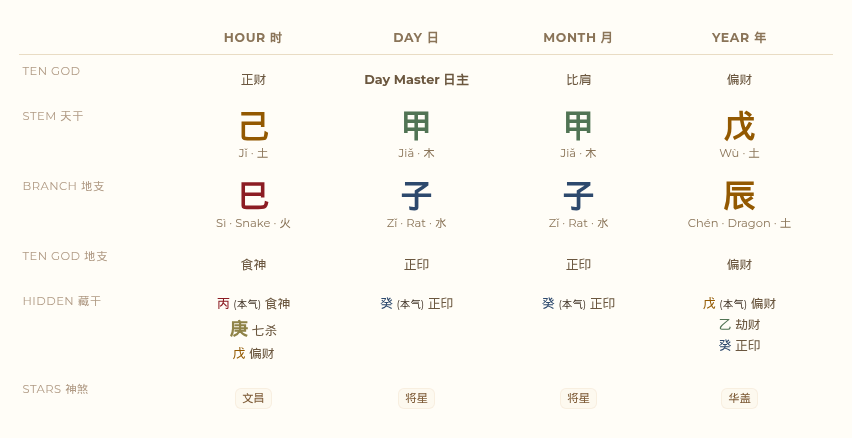
The Day Master is 甲 wood, and the month branch is 子, which is water. The chart has 子 water twice, in the Month and Day branches.
Structure. The main stem inside 子 is 癸 water. For 甲 wood, water is the Resource element, so the month sets a Resource structure (正印格). Resource is in the group that is handled by supporting it. On this question, the chart centres on water.
Climate. The 穷通宝鉴 says this about 甲 and 乙 wood born in a 子 month: "盘屈在地,欲土多而培养。恶水盛而忘形。……火重见温暖有功。" The wood lies coiled on the ground. It wants earth to hold it, it suffers when water floods it, and fire brings warmth that does real work. With two 子 water branches, water is already loud in this chart. So this question asks first for fire, and it warns against adding more water.
Strength. 甲 wood born in a 子 month does not have the month (失令). A slogan calculator stops there: weak wood needs support, water feeds wood, so add water. The 子平真诠 has already said that lacking the month only opens the strength question. This Day Master has a 甲 beside it in the Month stem and a water root directly under it. Whether it ends up strong enough, or swamped by all that water, is a judgment that takes the whole chart.
So the three questions point three different ways. Structure centres on water. Climate wants fire and warns against more water. A naive strength rule would add still more water, which is exactly what the climate question warns against.
How a practitioner puts the three together
A practitioner names all three, then weighs them. In some charts climate is urgent and leads. In others the structure, and whatever rescues it, leads. The ten-year luck cycles also change which tension is active at a given time, which What Are Bazi Luck Cycles? covers.
This is why one element on a results screen can't settle your useful god. The calculator can give you an accurate chart. The weighing still needs a person reading the whole of it. How to Read a Bazi Chart walks through where each of these pieces sits on your chart.
Look at your own chart and ask yourself: when you've followed advice to add the one element you were told you lack, did your situation actually change, or did something else in your life turn out to matter more?
Check your Day Master and month branch in the Bazi Calculator. For a Bazi Reading with Master Yuan of bazi.sg, it is S$180 by PayNow on WhatsApp, or S$186.85 by card. Each session is 60 minutes, face to face in Singapore or virtual.
